TIMBER INSECTS
Old holes.
New questions.
A report mentioning insect holes should explain the evidence, the access and whether activity or timber strength remains uncertain. It is not automatically an instruction to spray the house.
Define the timber investigation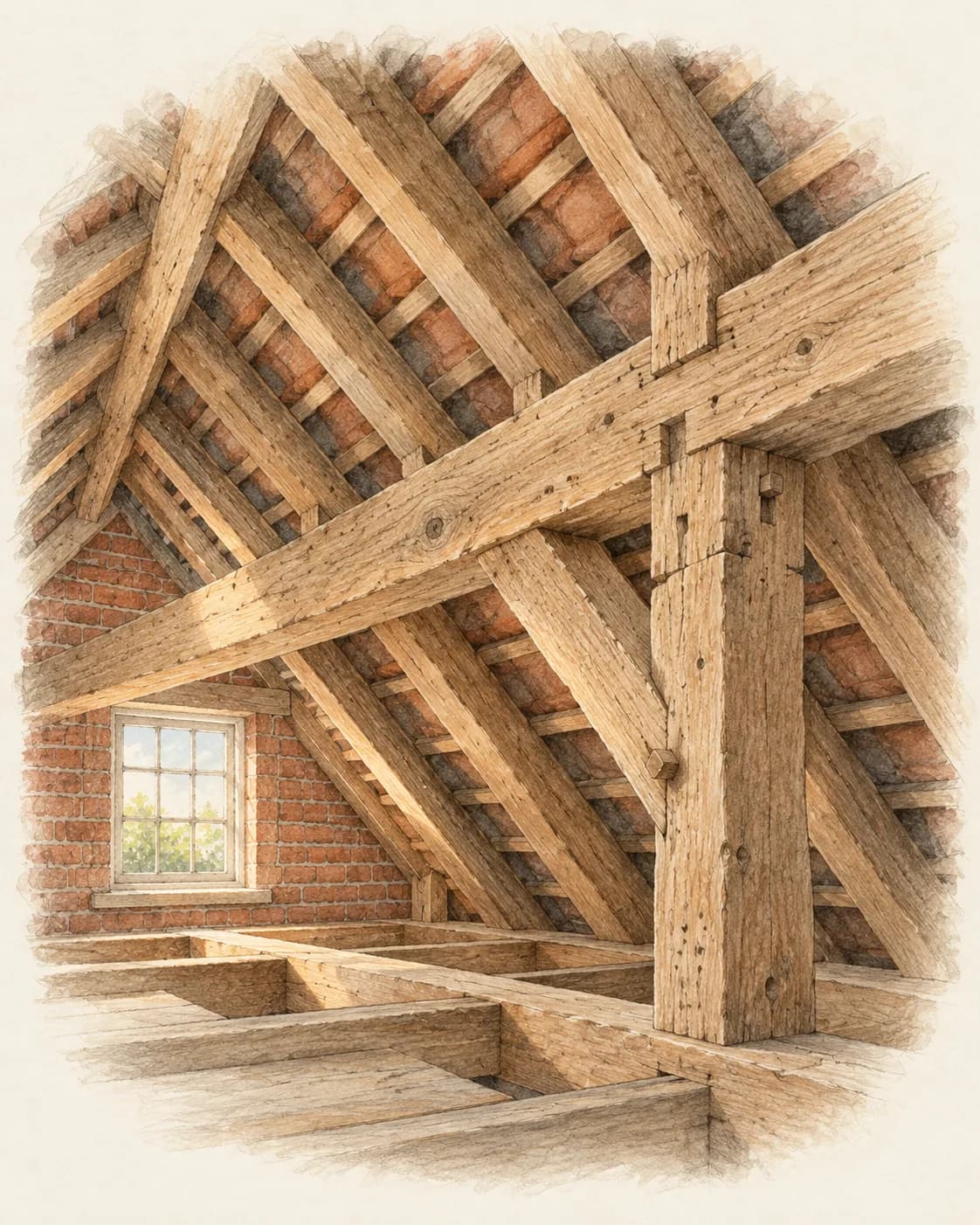
TIMBER / AN EVIDENCE SEQUENCE
A hole stays.Activity needs evidence.
- 01Record
Locate the affected timber.
- 02Interpret
Assess activity in context.
- 03Decide
Define monitoring or action.
Fictional architectural illustration. Illustrative study · not a diagnosis or construction specification.
The answer
Establish whether an infestation is active before choosing treatment.
“Woodworm” describes damage associated with wood-boring insects. Exit holes can remain after an infestation has ended. A useful investigation considers the timber, signs of activity, moisture conditions and extent of damage, with clear limitations where the structure is concealed.
The questions that matter
Define the enquiry.
- 01
Locate the evidence
Identify the particular boards, joists, roof timbers or joinery referred to in the report. Ask whether holes, dust, insects or weakening were actually observed. A general sentence about the risk in old buildings is different from a finding at the property.
- 02
Assess activity carefully
Dust or frass and fresh-looking holes may support an enquiry, but old material can remain undisturbed or be displaced later. Species, season and access affect interpretation. Ask the specialist what supports a conclusion of current activity and whether monitoring is appropriate.
- 03
Consider the timber’s job
A few marks on an exposed board cannot establish the condition of the concealed joists below. Conversely, little visible surface damage does not prove that a structural member retains its strength. Record the areas examined and any bearing or support concerns.
- 04
Understand previous treatment
Ask for the earlier report, specification, treated areas, date and guarantee terms. A certificate for one part of the building does not describe every timber or establish that today’s conditions are unchanged. The new investigation should assess the present evidence.
Signs to look for
Signs of active woodworm, and what each one proves.
The Property Care Association (PCA) lists three signs a householder can look for: small round exit holes of about 1 to 2 mm; fine bore dust, called frass, around or near them; and dead adult beetles close to the timber: PCA: signs of woodworm (opens in a new tab).
No one of them settles whether an infestation is alive. An exit hole marks where an adult beetle left, and it stays after the insects have gone. Small piles of dust, most obvious as trails below holes on a vertical surface, are the usual sign of activity, yet the PCA warns that in an undisturbed space even dust can mislead. Dead beetles are among the better indicators, though they too can be left from an attack that has ended.
Moisture matters as much as the insect. The PCA’s advice is that timber with a sufficiently low moisture content is highly unlikely to sustain an infestation, and that an attack may already have died out because the timber dried, was unsuitable or was treated before. That is why it says activity has to be established before any treatment is justified.
Which insect made the holes changes the answer as well. The table below sets out the beetles the association describes for householders: PCA: woodworm beetles (opens in a new tab).
Identification
Which beetle, by the timber and the dust.
| Beetle | Timber it is found in | What marks it out |
|---|---|---|
| Common furniture beetle | A wide range of timber, including structural timbers and furniture. The most abundant wood-destroying insect in UK buildings. | Round exit holes of about 1 to 2 mm; coarse, gritty, lemon-shaped bore dust. Adults emerge in spring and summer, after two to four years as larvae in the timber. |
| Deathwatch beetle | Partly decayed hardwoods, chiefly oak. Most often found in historic buildings. | Larger exit holes of about 3 mm; bun-shaped pellets in the dust. Adult beetles on nearby floors are the best sign of activity. |
| Powderpost beetle | Unseasoned or recently dried hardwoods, chiefly oak. | Exit holes of similar size to the furniture beetle’s, usually filled with fine, flour-like dust. |
| Wood-boring weevil | Damp, at least partly decayed timber, often behind skirting boards and at decaying wall plates. | Channels on the timber surface. Normally controlled by dealing with the wet rot. |
| Bark borer | Bark left on building timbers, particularly rafters. | Holes in the bark, which can be mistaken for furniture beetle. The attack is normally confined to the bark. |
Read the evidence
The question is bigger than the number of holes.
An insect investigation should explain, where it can, what caused the damage, whether there is evidence of activity, the affected extent and the implications for the building. It should also say where the evidence is inconclusive. Avoid treating a quoted chemical application as proof that a diagnosis has already been made.
Moisture conditions and the nature of the timber can influence insect attack. Where a report also records dampness, poor subfloor ventilation or decay, ask the investigator to consider those concerns together. Restoring suitable conditions, monitoring, targeted treatment or timber repairs are different possible instructions; the evidence should determine what is proposed.
Before anyone lifts boards or enters a void, arrange permission and appropriate safe access. Do not crawl into a confined floor space, remove potentially hazardous materials or disturb finishes merely to obtain more photographs. If access cannot be obtained before purchase, discuss the unresolved risk with your professional advisers rather than assuming a clean result.
Scope and limits
Read the evidence at the right strength.
| Record | What it tells you | What it does not settle |
|---|---|---|
| Exit holes | The timber has evidence consistent with past insect emergence. | Whether the infestation is active now. |
| Dust or frass | A potentially relevant observation to assess in context. | A reliable date or species diagnosis on its own. |
| Exposed boards | The condition of the surface and local area reached. | The whole concealed floor structure. |
| Treatment paperwork | What the document says was inspected or treated. | Current condition everywhere in the property. |
From the archive
A detail, in context.
Before you commit
Turn the finding into a useful instruction.
- 01
Ask a precise question
Send the report extract and ask whether the specialist will assess activity, extent and structural implications.
- 02
Compare the written scope
Check access, reporting, any monitoring proposal and whether the provider also quotes for treatment.
- 03
Review before purchase
Take significant unresolved timber concerns back to the surveyor and clarify any lender-specific evidence requirements.
Primary references
Read the source. Check the scope.
The decision rule
Resolve the significant unknowns with the right scope of professional advice before committing.
Understand further investigationsQuestions
A few good
questions.
Talk to us 01Do old woodworm holes mean I need treatment?
Not by themselves. Establish the present evidence of activity and the timber condition before agreeing treatment.
02Can a home survey guarantee there is no woodworm?
No. Concealed timber, restricted access and the limits of a visit mean that an absence of visible signs is not a guarantee.
03Is fresh dust proof of an active infestation?
It can be relevant, but it needs interpretation. The circumstances and other observations matter, and undisturbed old dust can be misleading.
04Should I buy a second general survey?
First clarify the existing finding. A focused timber investigation may answer the unresolved question more directly than repeating a general inspection.
05What are the signs of active woodworm?
The Property Care Association points to small piles of bore dust, called frass, around round exit holes of about 1 to 2 mm, and to dead adult beetles nearby. Dust can lie undisturbed and dead beetles can be left from an attack that has ended, so activity is established by inspection, not by one sign.
06What is a woodworm survey?
A timber investigation by a specialist, separate from a home survey. It examines the affected and surrounding timbers to establish whether an infestation is active or historic, which insect is involved, how far it extends and whether any treatment is justified.