Understand the defects, repairs and decisions behind a more complex home.
Level 3 from £570Confirm your total with the property details
A Level 3 Building Survey in Sheffield costs from £570, fixed. Understand the home before you commit: a named, RICS-regulated practice, a clear report and a conversation afterwards.
Read the roofline, the rooms and the ground below.
A stepped terrace, an altered Nether Edge villa and a later family house raise different questions. Establish the plot levels, retaining structures and alteration history for the address; Sheffield's hillside setting does not establish a defect or the cause of a crack.
For an older or substantially altered Sheffield home, give the practice the building and plot history. Ask for accessible roof, floor and retaining details to be considered together, with limits and any need for engineering or further access made clear.
Buying a later home or a new build? +
Choose the inspection for the home you are buying: its construction, condition and alterations matter alongside its age.
A later home being resold
A later house may benefit from Level 3 where substantial alterations, unusual construction or visible defects need a more detailed assessment. For a straightforward home in reasonable condition, discuss whether Level 2 would be sufficient.
Request records for later work, building-control completion documents and any remaining warranty cover. For a flat, also ask about shared parts, planned works and the managing agent’s records.
Ask which inspection you need: a pre-completion or snagging inspection and a home survey have different agreed scopes. Confirm access, timing, the developer’s outstanding-work list and the warranty terms. A Level 2 or Level 3 quote here does not include a separate snagging inspection.
Sheffield’s hills and valleys place stone and brick terraces, Victorian villas, inter-war suburbs and newer development across noticeably different settings. Retaining structures, stepped gardens, altered rooflines and changes in level are common reasons to ask a more joined-up question about a home.
Questions to take to the viewing +
Read cracks as a pattern.
Note the location, direction and any matching internal signs, then ask when repairs were carried out. One crack alone is not a diagnosis.
Look below the garden line.
Where the plot steps away, look at retaining walls, boundary structures, drainage outlets and any recent landscaping as well as the house itself.
Map roof alterations.
Dormers, rear extensions and roof changes need their documents checked separately from the visual inspection—keep the planning and building-control evidence.
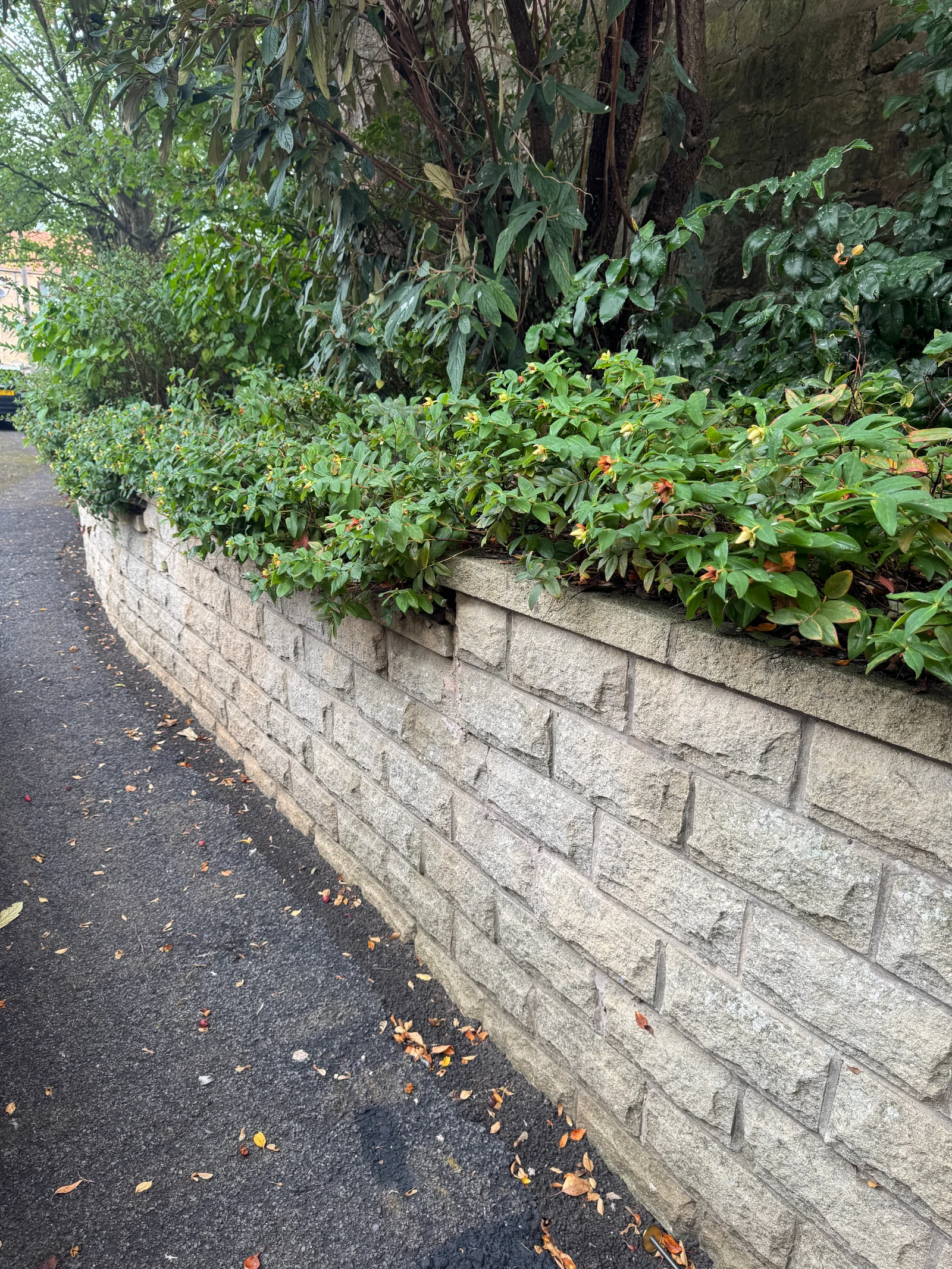
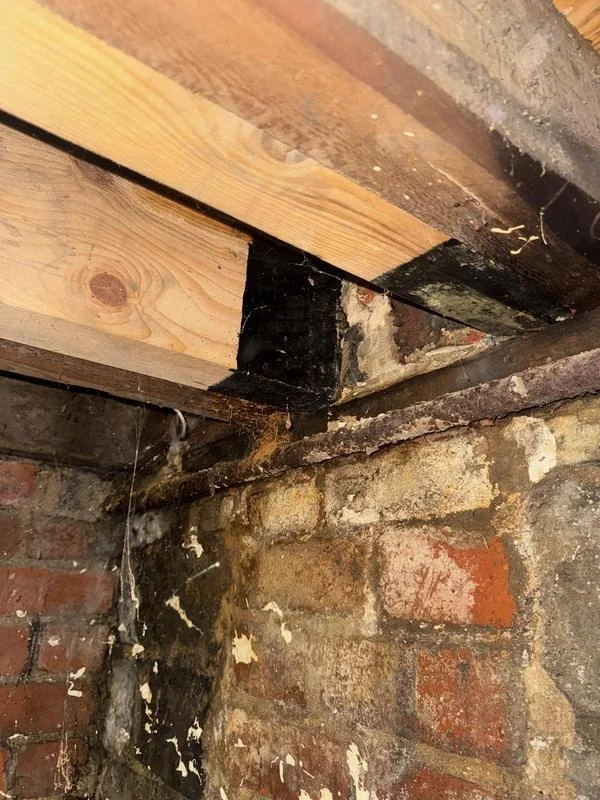
A retaining-wall crack and a floor support illustrate separate parts of the building's setting and structure. Access and ownership records help define the enquiry.
Real photographs from the survey archive, selected for the topics on this page. These are not local case histories or findings at your property.
A stepped crack and open joints in a garden retaining wall.
Questions for this area
For a Sheffield garden beside higher ground, ask about the wall's repair history, drainage and maintenance responsibility. The crack pattern needs assessment with the retained ground and wider structure; a photograph cannot establish stability.
Pale timber members alongside older, darker joists above the cellar wall and metal support.
Questions for this area
For an altered Sheffield terrace or villa, share records of floor-support work and ask which bearings can be inspected safely. The visible timbers and masonry need interpreting together. This archive detail does not certify the adequacy of a repair.
FROM THE SURVEY ARCHIVE / SHEFFIELD
A real finding. Its original context.
These anonymised findings come from issued reports for properties in Sheffield. They describe those inspections, rather than a diagnosis of homes across the city.
The visible obstruction and incomplete rainwater details were defects requiring attention. The report explained the risk of water discharging onto adjacent walls and ground.
Official figures for homes in and around Sheffield: what was built and when, what has sold, what is protected and who holds the files. They describe the area. They are not findings about the home you are buying.
How Sheffield grew
Sheffield takes its name from the River Sheaf; the early town ran from the 12th-century castle at the meeting of the Don and Sheaf up to the parish church, and its first market charter was granted in 1296. It was established as a centre of metal working and cutlery by the late 16th century, the Company of Cutlers was formed in 1624, and Benjamin Huntsman's invention of crucible steel in the 1740s carried the industry further. City status was granted in 1893 and the new Town Hall opened in 1897, after street widening from the 1870s had rebuilt much of the old centre. The city centre conservation area is marked by dense streets, a fairly consistent building height and the use of local sandstone or red brick.
Nearby, in neighbouring council areas: Coal Aston (North East Derbyshire), Eastwood (Rotherham), Eckington High Street (North East Derbyshire), Eckington and Renishaw Park (North East Derbyshire).
The Environment Agency maintains 38 flood warning areas within 4 km of the centre of Sheffield, covering River Loxley, Porter Brook, River Don. Each one covers particular streets, not the whole town.
The coal mining reporting area is where the Mining Remediation Authority recommends a mining report. Its Development High Risk Area is the part with coal mining features recorded at or near the surface, such as mine entries and shallow workings.
24% of homes in Sheffield were built between 1945 and 1972, against 25% across England and Wales. Some estates of that period used non-traditional systems, so tell the practice if the listing or lender mentions non-standard construction. Surveying a 1960s or 1970s house.
Order the coal mining report early
14% of postcodes in Sheffield are in the Development High Risk Area, where mine entries, shallow workings or similar features are recorded at or near the surface. Ask your conveyancer for the coal mining report before you commit, and tell the practice if it shows a mine entry or a past subsidence claim. Subsidence and cracks explained.
Check heritage status before planning any work
Historic England records 1,151 listed buildings and 33 conservation areas in and around Sheffield. Listing and conservation-area controls apply address by address, so confirm the status of the exact property before budgeting for windows, roofs or extensions. Listed and period buildings.
Look up the flood record for the address
There are 38 flood warning areas within 4 km of the centre of Sheffield, including on the River Loxley and Porter Brook. A warning area covers particular streets, so check the long-term risk for the exact postcode and ask the seller about past flooding.
Put the survey fee in proportion
A Level 3 survey from £570 is about 0.3% of the median price paid for a home in Sheffield (£215,000). Your own fixed fee appears once you enter the property's details. See the full price register.
Sources and method. Records compiled 12 November 2026; council links checked 12 November 2026; building control, parish council and water company links added 14 November 2026.
Each place starts from the extent Ordnance Survey publishes for it in OS Open Names. Housing, tenure and sale figures use the live residential postcodes inside that extent that belong to the same ONS built-up area as the place itself; census and Valuation Office figures cover the 2021 neighbourhoods (LSOAs) with at least half of their postcodes in that set. Heritage records are those inside the extent, and flood areas those within the stated distance of its centre, so both can include neighbouring settlements. Coal figures are the share of the same postcodes that fall inside the Mining Remediation Authority's published areas. The water and sewerage companies are those whose published boundaries hold the same postcodes; a small appointed company serving one estate is counted separately and not named.
This is the area measured for Sheffield: 9,930 live residential postcodes in an extent 16.5 km wide and 14.7 km tall.
For older, altered, unusual, larger or visibly defective homes, get a deeper explanation of visible defects, repair options and priorities within the agreed inspection scope.
01
The inspection
The practice inspects the accessible property to the agreed survey level.
02
The written findings
Condition ratings and clear advice help you understand the issues and the next enquiries.
03
The conversation
A follow-up with the inspecting practice helps you work through the report. The practice confirms access and report timing after instruction.
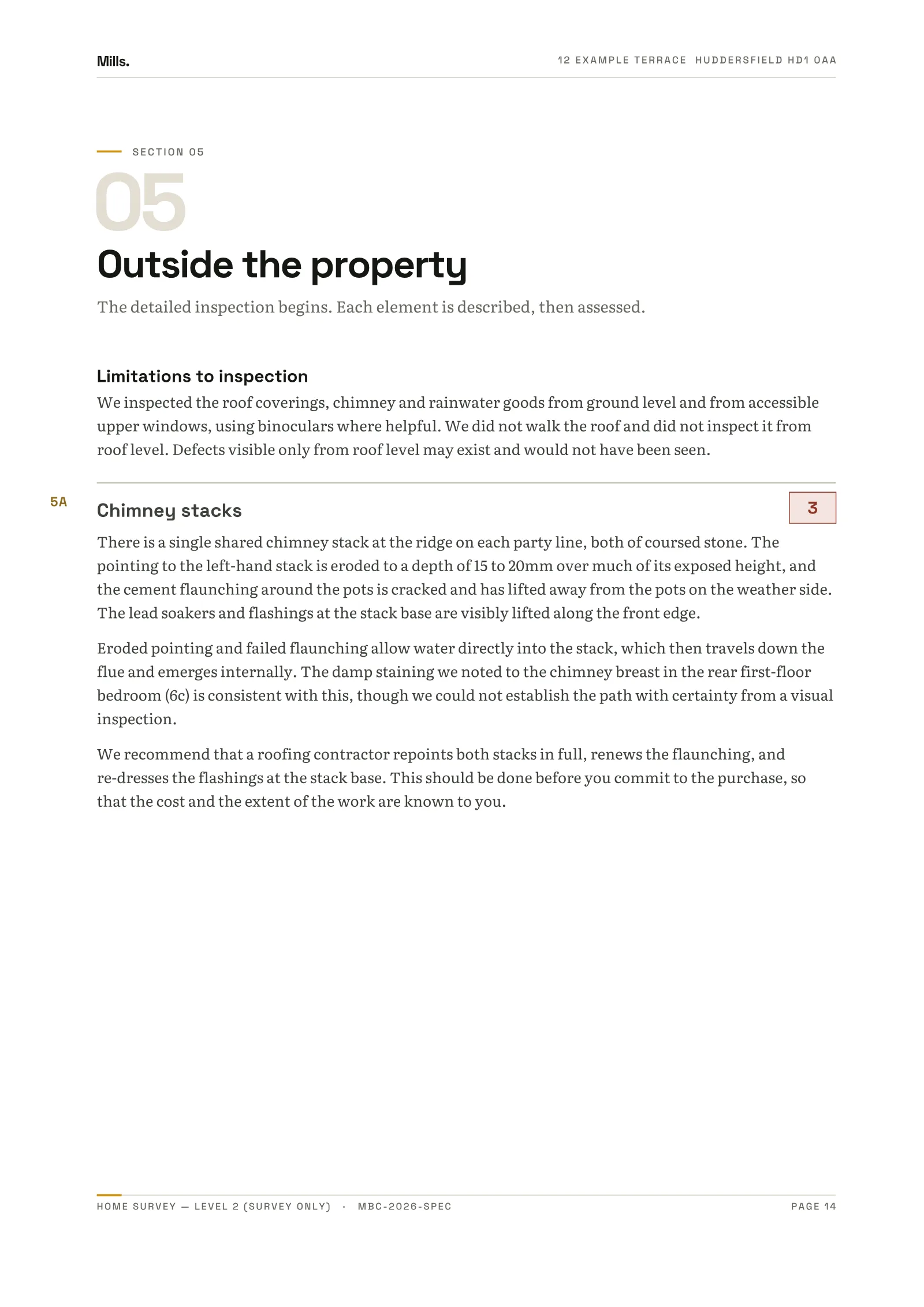
The specimen records a ground-level inspection, with accessible upper windows and binoculars where helpful. It also says the roof was not walked. Read the limits alongside the findings; unseen areas remain uncertain.
RICS-regulated practices. Checked before matching.
01
PRACTICE CHECKRICS regulation and insurance checked
A practice cannot be quoted until its RICS firm registration and professional indemnity insurance have been checked.
02
RECOGNISED SCOPECurrent RICS standard
Delivered in line with the current RICS Home Survey Standard.
03
CLEAR RESPONSIBILITYPlatform matched. Practice accountable.
SurveyChoice quotes, matches and books. The named practice delivers the professional service.
BEFORE YOU COMMIT / YOUR RESEARCH
Good questions. Better information.
Bring the physical condition and the records together. Your surveyor explains accessible condition; your conveyancer investigates legal matters and the searches appropriate to your purchase.
01How much does a Level 3 Building Survey cost in Sheffield?+
Published Level 3 prices currently start from £570. The exact fixed price depends on the agreed purchase-price band, property type and bedroom count—not a sales callback. The live quote checks those inputs and the exact outward postcode.
02Do you have RICS surveyors in Sheffield?+
Enter the property postcode to check current availability in Sheffield. SurveyChoice matches eligible properties to a named, RICS-regulated practice. You see the practice and its professional terms before completing the instruction.
03Which house survey do I need in Sheffield?+
Level 2 is commonly suited to a conventional home in reasonable condition. Level 3 is the deeper option for an older, altered, unusual, larger or visibly defective property. The building and your concerns matter more than the town name.
04Is every S postcode currently covered?+
The districts listed on this page are covered today. Availability can still vary with the practice’s capacity, so check the property’s exact postcode before entering your contact details.
05Who carries out the survey?+
The quote engine matches the property to an available RICS-regulated practice, and the practice’s RICS surveyor carries out the inspection. SurveyChoice checks every practice’s RICS regulation, insurance and terms; the practice is named before the instruction is completed.
06How can I compare cheap house surveys in Sheffield?+
Compare the same property type, purchase-price band, bedroom count and survey level. Check the final total, any valuation, inspection scope and who provides the report. SurveyChoice shows a fixed total before contact details; its published price is not a claim to be the cheapest provider for every property.
07When can you inspect my property in Sheffield?+
Enter the exact postcode to check whether a practice can quote. The practice confirms access and report timing after instruction. If you have an exchange deadline, discuss it before committing; a starting price does not promise a particular inspection date.
Explore housing and Level 3 survey questions across the wider region. These are property guides; check the exact postcode separately for an available practice.