HOME SURVEYS / LN
Level 2 Home Survey in Lincoln.
Know what needs attention before you commit.
Level 2 from £335Confirm your total with the property details
A Level 2 Home Survey in Lincoln costs from £335, fixed. Understand the home before you commit: a named, RICS-regulated practice, a clear report and a conversation afterwards.
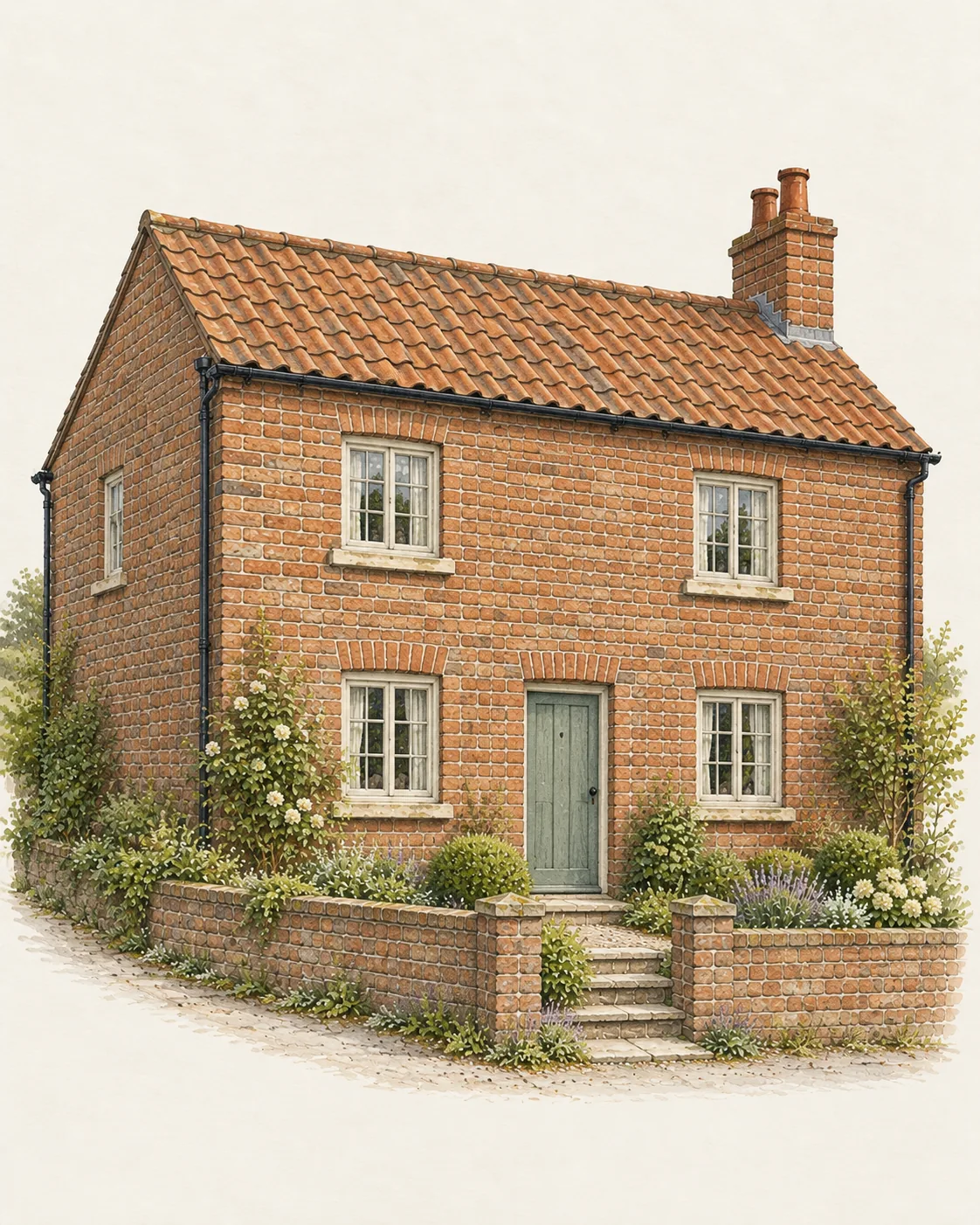 View larger illustration
Historic fabric and later homes. Choose the right depth.
- 01Listed and sloping plots
- 02Article 4 addresses
- 03Three councils, one local plan
01 / THE PRICE, EXPLAINED
Your home.
Your fixed price.
Level 2 from £335, Level 3 from £570. The property type, bedrooms and purchase price set your total. These examples use the current booking rate card.
No tax or SurveyChoice booking fee is added afterwards. Your exact postcode checks available practice coverage. Rate card last updated 20 August 2026.
| Property | Purchase price | Level 2 | Level 3 |
|---|---|---|---|
| 1–2 bedroom flat | Up to £250,000 | £335 | £570 |
| 3 bedroom house | Up to £250,000 | £365 | £600 |
| 4 bedroom detached house | £250,000–£350,000 | £510 | £745 |
02 / KNOW THE LOCAL PICTURE
Up the hill, out to the garden suburb, over the boundary.
An older house near the cathedral, a Swanpool garden-suburb home and an extended house beyond the city edge need different evidence. Start with listing, the address-level planning controls and which council holds the records. Lincoln's conservation areas reach from the historic core along the High Street and out to Swanpool; check the exact boundary for the address.
Level 2 can suit a conventional Lincoln home in reasonable condition after the practice considers its construction and alterations. Tell it about listing, a changing ground level, roof rooms or extensions before the scope is agreed.
Buying a later home or a new build?
Choose the inspection for the home you are buying: its construction, condition and alterations matter alongside its age.
A later home being resold
Level 2 may suit a conventionally built house or bungalow in reasonable condition. Tell the practice about extensions, converted roof rooms, removed walls and known concerns before booking.
Request records for later work, building-control completion documents and any remaining warranty cover. For a flat, also ask about shared parts, planned works and the managing agent’s records.
Compare Level 3 for this homeBuying a brand-new home from a developer
Ask which inspection you need: a pre-completion or snagging inspection and a home survey have different agreed scopes. Confirm access, timing, the developer’s outstanding-work list and the warranty terms. A Level 2 or Level 3 quote here does not include a separate snagging inspection.
Snagging or a home survey?The local housing mix
Lincoln ranges from historic masonry on and around the uphill area to suburban estates and rural-edge homes. Older fabric, changes in level and later additions may deserve more attention, while a conventional modern house may call for a simpler Level 2 condition record.
Questions to take to the viewing
Check heritage status before planning changes.
If a property is historic or near the core, check whether it is listed or subject to local constraints before assuming future alterations will be straightforward.
Read old masonry with its repairs.
Ask what material was used for pointing, render or paint and whether it followed water ingress or structural work. Keep records with the property file.
Watch changes in level.
On a sloping plot, look at retaining walls, steps, drainage and where water is directed. These are viewing prompts, not a judgement about stability.
03 / BEYOND THE FIRST IMPRESSION
The edges of older fabric.
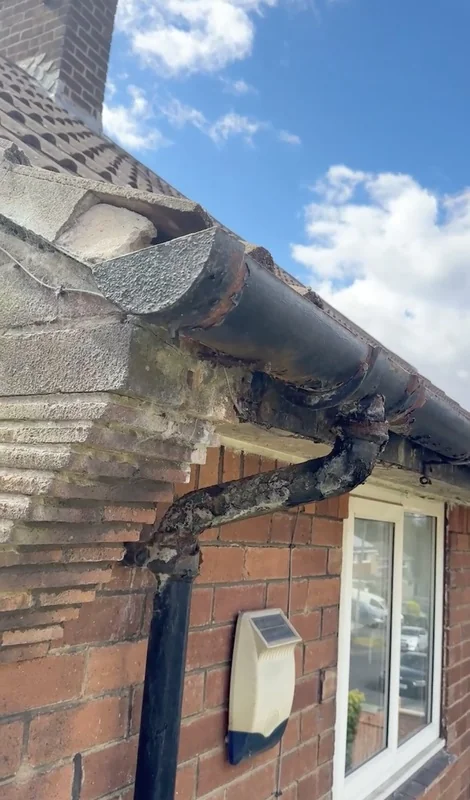
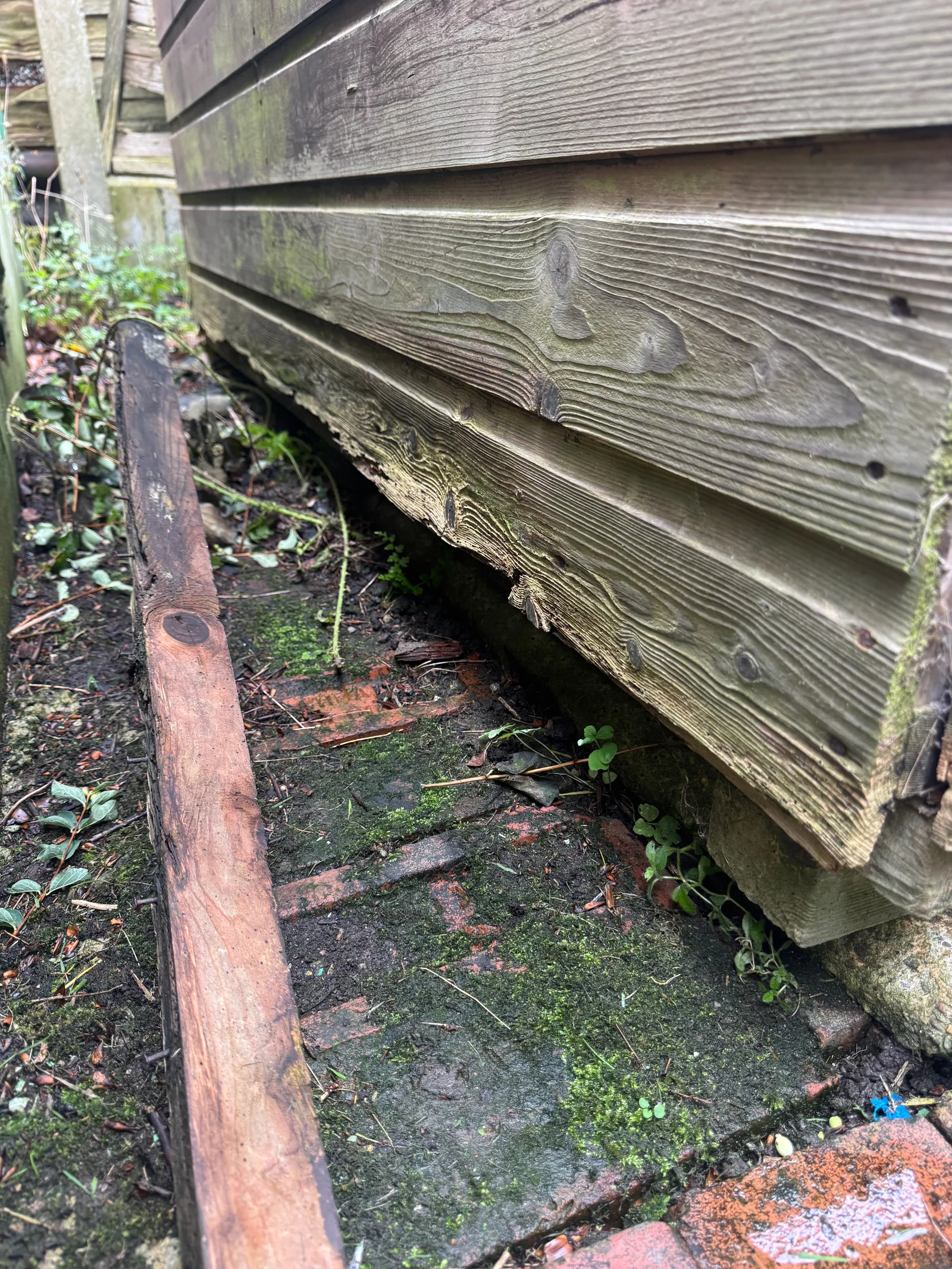
An eaves detail and the lower edge of timber cladding illustrate the weathering and maintenance questions that sit alongside a building's age.
Real photographs from the survey archive, selected for the topics on this page. These are not local case histories or findings at your property.
 View detail
Corroded gutter and downpipe
Corrosion and flaking coatings on a metal gutter and downpipe, with deterioration along the roof edge.
Questions for this area
For an older Lincoln house on the hillside, ask when metal gutters and downpipes were last repaired or replaced, and whether listing or an Article 4 direction affected the choice. Corrosion at this archive roof edge is local; it does not show whether water has entered the wall behind.
 View detail
Deteriorated lower timber cladding
Loss of timber along the lowest cladding boards, leaving a gap above the ground.
Questions for this area
For a Lincoln home with timber cladding close to the ground, look at how the boards finish above paving and planting. These archive boards have decayed at their lower edge; the photograph cannot establish the condition of the framing behind or of cladding elsewhere on the building.
04 / PUBLIC RECORDS / LINCOLN
Lincoln,
on the record.
Official figures for homes in and around Lincoln: what was built and when, what has sold, what is protected and who holds the files. They describe the area. They are not findings about the home you are buying.
How Lincoln grew
Industry transformed Lincoln from the mid 19th century: the railway arrived in 1846, and the first houses of the Sincil Bank area, in Monson Street, were built in the same year. Dense terraces were laid out between Canwick Road and the High Street to house the large numbers employed in the huge engineering works nearby, as close to the factories as possible so that workers could walk to them. Ripon Street was developed from about 1860 and streets were still being added in 1911; in 1901 most of those in the area whose occupation was recorded worked in engineering, and most people in Ripon Street had moved to Lincoln from elsewhere. Later housing drew on the garden city movement, in the largely incomplete Swanpool Garden Suburb on Skellingthorpe Road and the St Giles estate off Wragby Road, and in the 1970s the City Council replaced some of Sincil Bank's older houses with flats.
From Sincil Bank, Revitalised: A place shaping framework (2017) (opens in a new tab), City of Lincoln Council.
The homes in numbers
42,522 households in the 60 census neighbourhoods that best match Lincoln. The marker on each bar shows the England and Wales share.
| Homes | Lincoln | England and Wales |
|---|---|---|
| Terraced | 30% | 23% |
| Semi-detached | 31% | 32% |
| Detached | 20% | 23% |
| Flats and maisonettes | 20% | 22% |
51% of households own their home, 28% rent privately and 21% rent from a council or housing association.
| Homes | Lincoln | England and Wales |
|---|---|---|
| Before 1900 | 16% | 15% |
| 1900 to 1918 | 7% | 5% |
| 1919 to 1939 | 11% | 14% |
| 1945 to 1964 | 16% | 16% |
| 1965 to 1982 | 16% | 18% |
| 1983 to 1999 | 13% | 12% |
| 2000 to 2009 | 10% | 7% |
| 2010 onwards | 10% | 12% |
What homes sold for
£195,000median price paid across 1,109 sales, 1 October 2025 to 30 September 2026
| Type | Median paid | Sales |
|---|---|---|
| Terraced | £163,000 | 402 |
| Semi-detached | £205,000 | 363 |
| Detached | £292,750 | 264 |
| Flats and maisonettes | £115,500 | 80 |
Standard sales registered with HM Land Registry; recent months are incomplete. A median says nothing about the value or condition of one home.
Protected buildings and places
- Listed buildings
- 456
- 44 Grade I, 40 Grade II*, 372 Grade II
- Conservation areas
- 11
- In Historic England’s dataset, which is not complete
- Scheduled monuments
- 27
- 3 registered parks and gardens
- Heritage at risk
- 16
- Entries on the 2026 register
What the list holds, grouped by the main word in each entry’s listed name
- 264 houses, cottages and halls
- 48 memorials, walls, gates and street furniture
- 44 other named buildings
- 43 inns, shops, schools and public buildings
- 27 churches and chapels
- 14 bridges, canal and railway structures
- 11 farmhouses and farm buildings
- 5 mills, works and warehouses
Treat the split as a guide; the list entry itself is the record.
Highest-graded entries nearby
- 46 and 47, Steep Hill (opens in a new tab) Grade I
- Atherstone Place (opens in a new tab) Grade I
- Bishops Palace (Remains) (opens in a new tab) Grade I
- Cantilupe Chantry South (opens in a new tab) Grade I
- Cathedral Church of St Mary and Cloisters and Chapter House and Libraries (opens in a new tab) Grade I
- Church of All Saints (opens in a new tab) Grade I
Conservation areas
- Cathedral and City Centredesignated 1968
- St Peter-at-Gowtsdesignated 1975
- Lindum and Arboretumdesignated 1976
- St Catherinesdesignated 1979
- Carlinedesignated 1983
- Gowt's Bridgedesignated 1983
- Newport and Nettleham Roaddesignated 1983
- Sibthorpdesignated 1983
- The Delldesignated 1983
- West Parade and Brayforddesignated 1983
- Swanpooldesignated 1986
Nearby, in neighbouring council areas: Burton (West Lindsey).
Boundaries decide what applies to a house. Confirm the address on City of Lincoln Council’s conservation area pages (opens in a new tab).
Scheduled monuments include Lincoln Roman colonia (Lindum) (opens in a new tab), Lincoln Roman cemetery (opens in a new tab), Roman remains beneath Boots building (opens in a new tab). Registered parks and gardens include Boultham Park (opens in a new tab), Hartsholme Park (opens in a new tab), Lincoln Arboretum (opens in a new tab). On the Heritage at Risk Register: Church of St Peter at Gowts, High Street, Lincoln (opens in a new tab), Church of St Swithin, Free School Lane, Lincoln (opens in a new tab), Stonebow and Guildhall, High Street (opens in a new tab).
Flood warning areas
The Environment Agency maintains 8 flood warning areas within 3.8 km of the centre of Lincoln, covering River Witham, Sincil Dyke, Great Gowts Drain. Each one covers particular streets, not the whole town.
- Fossdyke Canal and Tributaries from Torksey to Lincoln including Saxilby (opens in a new tab)
- Isolated properties and villages near the River Witham and River Brant from Claypole to Lincoln (opens in a new tab)
- River Witham and South Delph from Lincoln to Washingborough (opens in a new tab)
- River Witham to the east of Lincoln (opens in a new tab)
- and 4 more
For one address, use Check the long term flood risk (opens in a new tab) and ask the seller in writing whether the property has flooded.
Coal mining
None of the postcodes measured for Lincoln are in the coal mining reporting area, the area where the Mining Remediation Authority recommends a mining report. Other kinds of mining are recorded separately.
A share of postcodes says nothing about one plot. For an address, use Check if a property is affected by coal mining (opens in a new tab) or the Mining Remediation Authority map viewer (opens in a new tab); a conveyancer normally orders the report with the other searches.
Who holds the records
City of Lincoln Council (opens in a new tab) decides planning applications and holds building control records for Lincoln. Lincolnshire County Council (opens in a new tab) is responsible for roads and for local flood risk management.
A newer estate can have its own appointed water company in place of the regional one. under 1% of the postcodes measured in Lincoln are inside such an area; the water bill names the supplier.
What this suggests you check
Much of the stock predates 1919
23% of homes in Lincoln were built before 1919, against 20% across England and Wales. Solid walls, older roofs and generations of alteration are more likely at that age, so compare Level 3 before settling on Level 2 for a house of that period. Surveying a Victorian house.
Check heritage status before planning any work
Historic England records 456 listed buildings and 11 conservation areas in and around Lincoln. Listing and conservation-area controls apply address by address, so confirm the status of the exact property before budgeting for windows, roofs or extensions. Listed and period buildings.
Look up the flood record for the address
There are 8 flood warning areas within 3.8 km of the centre of Lincoln, including on the River Witham and Sincil Dyke. A warning area covers particular streets, so check the long-term risk for the exact postcode and ask the seller about past flooding.
Put the survey fee in proportion
A Level 2 survey from £335 is about 0.2% of the median price paid for a home in Lincoln (£195,000). Your own fixed fee appears once you enter the property's details. See the full price register.
See these figures for all 316 towns, side by side. The table opens at Lincoln.
Sources and method. Records compiled 12 November 2026; council links checked 12 November 2026; building control, parish council and water company links added 14 November 2026.
Each place starts from the extent Ordnance Survey publishes for it in OS Open Names. Housing, tenure and sale figures use the live residential postcodes inside that extent that belong to the same ONS built-up area as the place itself; census and Valuation Office figures cover the 2021 neighbourhoods (LSOAs) with at least half of their postcodes in that set. Heritage records are those inside the extent, and flood areas those within the stated distance of its centre, so both can include neighbouring settlements. Coal figures are the share of the same postcodes that fall inside the Mining Remediation Authority's published areas. The water and sewerage companies are those whose published boundaries hold the same postcodes; a small appointed company serving one estate is counted separately and not named.
This is the area measured for Lincoln: 2,394 live residential postcodes in an extent 8.5 km wide and 7.6 km tall.
- OS Open Names, served by Postcodes.io (opens in a new tab), Ordnance Survey. Contains OS data © Crown copyright and database right 2026.
- ONS Postcode Directory and Built Up Areas (2024) (opens in a new tab), Office for National Statistics. Source: Office for National Statistics licensed under the Open Government Licence v3.0. Contains OS data © Crown copyright and database right 2026. Contains Royal Mail data © Royal Mail copyright and database right 2026.
- Census 2021, tables TS044 and TS054 (opens in a new tab), Office for National Statistics. Source: Office for National Statistics licensed under the Open Government Licence v3.0.
- Council Tax: stock of properties 2026, table CTSOP4.1 (opens in a new tab), Valuation Office Agency. Source: Valuation Office Agency, licensed under the Open Government Licence v3.0.
- Price Paid Data (opens in a new tab), HM Land Registry. Contains HM Land Registry data © Crown copyright and database right 2026. This data is licensed under the Open Government Licence v3.0.
- National Heritage List for England, Conservation Areas and Heritage at Risk Register 2026 (opens in a new tab), Historic England. © Historic England 2026. Contains Ordnance Survey data © Crown copyright and database right 2026. The Historic England GIS Data contained in this material was obtained on 12 November 2026. The most publicly available up to date Historic England GIS Data can be obtained from HistoricEngland.org.uk.
- Flood warning and flood alert areas (opens in a new tab), Environment Agency. This uses Environment Agency flood and river level data from the real-time data API (Beta).
- Development High Risk Area and Development Low Risk Area (opens in a new tab), Mining Remediation Authority. Contains public sector information licensed under the Open Government Licence v3.0.
- Find your local council and local service links (opens in a new tab), GOV.UK. Contains public sector information licensed under the Open Government Licence v3.0.
- Find an archive (opens in a new tab), The National Archives. Contains public sector information licensed under the Open Government Licence v3.0.
- Water Company Boundaries and appointed wastewater boundaries (opens in a new tab), Water UK and the water companies, on the Stream open data portal. Water Company Boundaries © Water UK. Appointed wastewater boundaries © Yorkshire Water, United Utilities, Severn Trent Water, Anglian Water Services and Dŵr Cymru Welsh Water. Licensed under CC BY 4.0 (https://creativecommons.org/licenses/by/4.0/). The shares of postcodes are worked out by SurveyChoice from the boundaries, simplified to 10 metres.
- List of .gov.uk domain names (opens in a new tab), Government Digital Service. Contains public sector information licensed under the Open Government Licence v3.0.
05 / A CLEARER NEXT STEP
A report you can
make decisions with.
Understand the condition of a conventional home in reasonable condition: what needs attention, what to maintain and what to raise before exchange.
- 01
The inspection
The practice inspects the accessible property to the agreed survey level.
- 02
The written findings
Condition ratings and clear advice help you understand the issues and the next enquiries.
- 03
The conversation
A follow-up with the inspecting practice helps you work through the report. The practice confirms access and report timing after instruction.
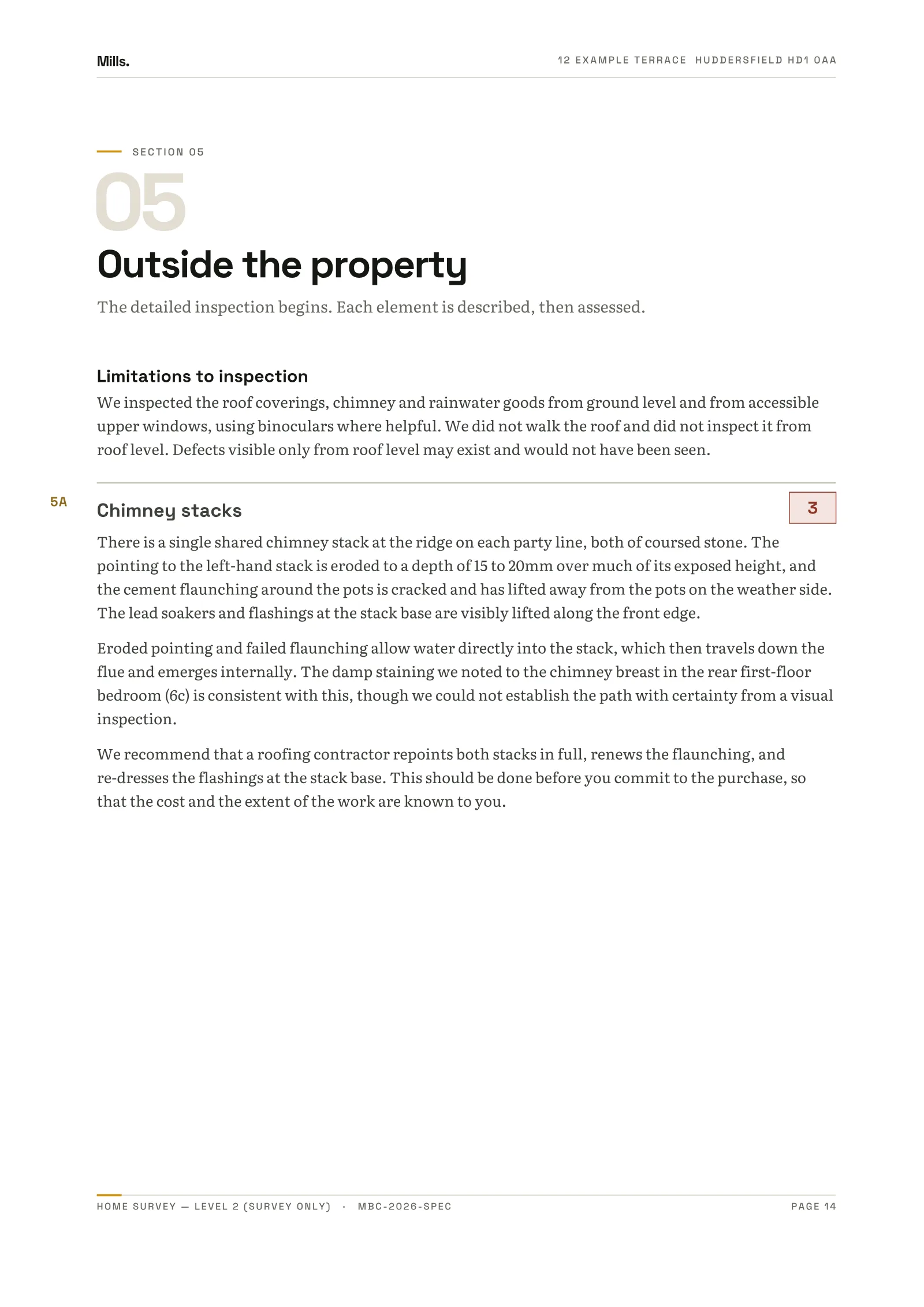
Explore a page of the report
What could actually be seen?
The specimen records a ground-level inspection, with accessible upper windows and binoculars where helpful. It also says the roof was not walked. Read the limits alongside the findings; unseen areas remain uncertain.
Your Lincoln survey, at a glance.
- Who inspects
- A named, RICS-regulated practice’s surveyor. Review the practice and its terms before you pay.
- What you get
- A written report to the RICS Home Survey Standard and a follow-up conversation with the inspecting practice.
- Coverage
- Check your exact postcode within LN1, LN2, LN3, LN4, LN5, LN6, LN8, LN9, LN10. Practice capacity can vary.
PROFESSIONAL ASSURANCE
RICS-regulated practices.
Checked before matching.
- 01PRACTICE CHECKRICS regulation and insurance checked
A practice cannot be quoted until its RICS firm registration and professional indemnity insurance have been checked.
- 02RECOGNISED SCOPECurrent RICS standard
Delivered in line with the current RICS Home Survey Standard.
- 03CLEAR RESPONSIBILITYPlatform matched. Practice accountable.
SurveyChoice quotes, matches and books. The named practice delivers the professional service.
BEFORE YOU COMMIT / YOUR RESEARCH
Good questions.
Better information.
Bring the physical condition and the records together. Your surveyor explains accessible condition; your conveyancer investigates legal matters and the searches appropriate to your purchase.
City of Lincoln conservation area maps
The council publishes a boundary map for each of its eleven conservation areas, from Cathedral and City Centre to Swanpool. Use the map for the address and check individual listing separately.
(opens in a new tab)OFFICIAL SOURCE / 02City of Lincoln planning register
Search the address for extensions, conversions and decisions. If the property is in North Kesteven or West Lindsey, use that council's register instead; the postcode lookup tells you which.
(opens in a new tab)Listed building survey: scope and cost
Historic construction, consent questions and the complexity that determines the right survey scope and fee.
Read the guide BUYER’S READING / 02“Damp” is not a diagnosis
Read moisture evidence in context: possible causes, inspection limits and the follow-up questions that matter.
Read the guide BUYER’S READING / 03Roof problems in a house survey: repairs, costs and next steps
A report mentioning slipped tiles does not automatically mean a new roof. A report describing distortion, decay and widespread covering failure needs a wider answer than replacing a few tiles.
Read the guideSTRAIGHT ANSWERS
Before you ask.
01How much does a Level 2 house survey cost in Lincoln?+
Published Level 2 prices currently start from £335. The exact fixed price depends on the agreed purchase-price band, property type and bedroom count—not a sales callback. The live quote checks those inputs and the exact outward postcode.
02Do you have RICS surveyors in Lincoln?+
Enter the property postcode to check current availability in Lincoln. SurveyChoice matches eligible properties to a named, RICS-regulated practice. You see the practice and its professional terms before completing the instruction.
03Which house survey do I need in Lincoln?+
Level 2 is commonly suited to a conventional home in reasonable condition. Level 3 is the deeper option for an older, altered, unusual, larger or visibly defective property. The building and your concerns matter more than the town name.
04Is every LN postcode currently covered?+
The districts listed on this page are covered today. Availability can still vary with the practice’s capacity, so check the property’s exact postcode before entering your contact details.
05Who carries out the survey?+
The quote engine matches the property to an available RICS-regulated practice, and the practice’s RICS surveyor carries out the inspection. SurveyChoice checks every practice’s RICS regulation, insurance and terms; the practice is named before the instruction is completed.
06How can I compare cheap house surveys in Lincoln?+
Compare the same property type, purchase-price band, bedroom count and survey level. Check the final total, any valuation, inspection scope and who provides the report. SurveyChoice shows a fixed total before contact details; its published price is not a claim to be the cheapest provider for every property.
07When can you inspect my property in Lincoln?+
Enter the exact postcode to check whether a practice can quote. The practice confirms access and report timing after instruction. If you have an exchange deadline, discuss it before committing; a starting price does not promise a particular inspection date.
MORE LOCATIONS / East Midlands
Explore surveys across East Midlands.
All areasLINCOLN / YOUR NEXT MOVE
A new home.
A clearer picture.
Start with the postcode. See the fixed price and review the practice before you commit.
Still choosing a survey? We can help.